

If you’ve been watching your heating bills inch higher every winter, you’re not alone. For millions of homeowners nationwide, the same question looms: Is there a better, less expensive way to heat their homes? I made my way down that road myself, and one of the options that kept coming up in my research was the outdoor wood boiler.
So I dug in — really dug in — to understand whether the savings are as real as people say. Spoiler: they can be significant. But the precise number is determined by a few critical factors. Let’s break it all down.
What Is an Outdoor Wood Boiler, Exactly?
Before we get into the numbers, a quick refresher for new readers. An outdoor boiler (also known as an outdoor wood furnace) is a wood-burning system that sits outside of your home — usually in the yard or next to some type of barn. It heats water, which is then pumped through insulated pipes that run underground into your home, shop, or whatever building you want to heat.
This configuration offers you a big advantage: You’re burning wood (a renewable, often locally available fuel) rather than depending only on propane, oil, or electricity. And that’s where the real savings start to kick in.
The Real Cost of Conventional Heating
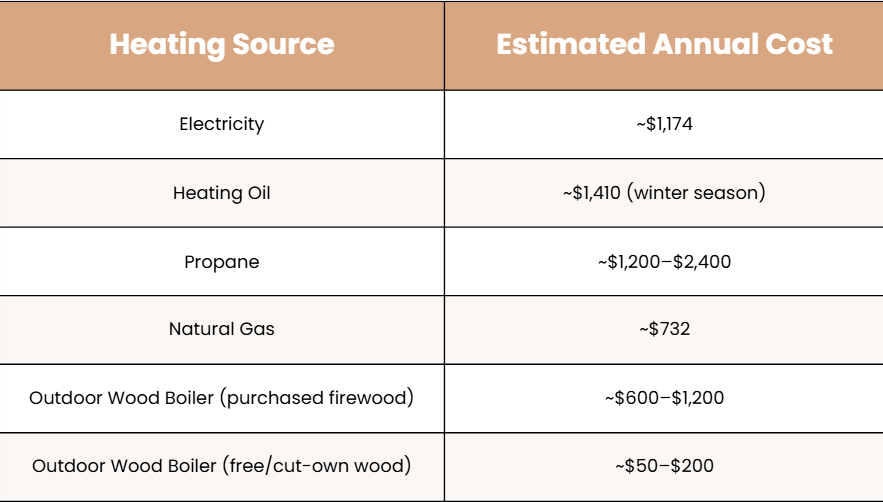
Before you know how much you can save, you need to know what you’re spending now. Based on figures from the Energy Information Administration (EIA), the average American homeowner pays approximately $1,174 for electricity and $732 for natural gas annually to heat their home. Propane users? And more — propane heating usually costs $90-$200 a month, or around about $1,080–$2,400 per heating season.
If you’re heating with fuel oil, the EIA estimates that you might spend roughly $1,410 from November to March alone.
Those figures hurt — especially when fuel prices vary erratically from one winter to the next.
How Much Does Wood Fuel Actually Cost?
Firewood is sold either by the cord, a stack 4 feet x 4 feet x 8 feet. According to the U.S. Forest Service, a median price for a cord of firewood is approximately $200 to $300, and most average-sized homes require about 3 to 4 cords in any heating season.
That gives you an annual wood fuel cost of roughly $600 to $1,200, anywhere from significantly less than propane or oil in most cases.
And here’s where I really perked up: wood fuel prices are historically steadier than oil or natural gas, which can fluctuate wildly with market conditions and global supply disruptions, as well as seasonal price increases. According to Penn State Extension, cordwood has been the cheapest heating fuel in their area for twenty years running—cheaper even than natural gas.
And if you have access to your own timber, or know someone who does, your firewood cost can be very close to zero, lowering the savings dramatically.
Crunching the Numbers: A Side-by-Side Comparison
Let’s put it all together with a simple comparison. These figures use average U.S. costs and a typical 2,000 square foot home: Even in the most conservative estimate — buying all your firewood — you’re likely saving hundreds of dollars per year compared to propane or oil. If you’re switching from electricity, the savings can be even more dramatic.
A lifecycle cost study from Michigan State University found that wood-based heating systems are significantly less expensive than propane over the long term, with propane running 26% or more above the cost of wood fuel across the life of the system.
Don’t Forget the Hidden Multiplier: Heating Multiple Buildings
One of the biggest yet most forgotten benefits of an outdoor wood boiler system is that one unit can support multiple buildings. Your house, your store, your barn, your garage — all from one boiler.
If you’re running separate heating systems for each outlet now, the collective savings add up quickly. This is part of what makes farms, homesteads and rural properties some of the most dramatic investment bang for your buck.
The magic here (or what makes this system efficient) is the pipe that connects your boiler to your buildings. Underground insulated pipe is specially crafted to reduce heat loss as hot water moves from the boiler to your buildings. Penny pinching here can cost you money later — good insulation is one job worth doing well.
What About the Upfront Cost?
It’d be remiss if I didn’t mention this to you. Outdoor wood boilers are not inexpensive to install. A good quality unit + install usually goes anywhere from $8,000 to 20k+, depending on system size and how many buildings you’re heating, as well as your local labor costs.
That sounds like a lot — but let’s put it into perspective.
If you pay $2,000 a year for propane and install a wood boiler that costs you $600 a year in firewood, you’re saving $1.400 per year. At that pace, a $10,000 system pays for itself in roughly seven years — and wood boilers are designed to last 20, 30, or even more than 40 years with maintenance.
Many homeowners say they see a full payback on their investment in three to seven years, depending on their existing fuel costs and how much wood they can obtain at low or no cost.
Factors That Affect Your Actual Savings
Not everyone will have the same savings, and I think we should be clear that people will not be able to pay less. Here’s what’s truly fueling the numbers:
- Switching from propane or heating oil is the best bet for a bang for your buck. Switching from already-affordable natural gas? Savings are there, but less dramatic.
- Your climate and heating load. In Minnesota or Maine, you’re heavily heating 6+ months of the year. That’s a lot of fuel — and more chances to save.
- Wood supply and price. If you can supply timber on your own land, your fuel costs drop to nothing. Even locally sold firewood is affordable compared with most conventional fuels.
- System efficiency and maintenance. A well-maintained outdoor wood boiler that’s properly set up will perform more efficiently — meaning you can burn less wood while generating the same amount of heat. Proper water treatment and other things here matter more than most people think.
- The fewer buildings you heat, the more buildings you can connect to one boiler, the better your cost-per-BTU math gets.
Is It Right for Everyone?
Honestly? No — and I’d rather tell you that up front than oversell it.
An outdoor wood boiler is a great fit if you:
- Live in a rural or semi-rural area with access to firewood
- Have significant heating needs (a large home, multiple buildings, or both)
- Don’t mind the regular maintenance involved (loading wood, managing the fire, occasional cleaning)
- Are you planning to stay in your home long enough to recoup the investment
It’s probably not the best fit if you’re in an urban area with no wood supply, if you’re heating a small well-insulated space, or if you prefer a fully hands-off heating solution.
FAQs
Q: How much can I realistically save in my first year? It varies depending on how much you are paying for heat now and where you get your wood. Homeowners who switch from propane often report first-year savings of $500 to $1,500 or more. For those who have access to free or low-cost wood, savings can be even greater.
Q: Does the boiler need to run all winter? You have full control. On days with lighter conditions, you might only fire it up a few days a week. In a deep freeze, you’ll fire it every day. From October to April, many homeowners rely on it as a primary heat source.
Q: Can I heat my domestic hot water with an outdoor wood boiler?Yes! Many systems are plumbed to also heat your household water, which can further reduce your electric or gas water heating costs — sometimes by $200–$400 per year all by itself.
Q: What’s the biggest mistake new owners make that hurts savings? Neglecting water treatment. Over time, untreated water inside your boiler system can corrode pipes and cause damage, costing you money in repairs and lost heat. This is a place where spending a little can prevent spending a lot.
Q: Where can I find more helpful tips and owner resources? The Outdoor Boiler blog is a useful place to start — it’s full of practical guides about installation, maintenance, and taking the most advantage of your system.
Conclusion
So how much can you save with an outdoor wood boiler? In reality, $500 to $2,000+ per year versus propane, oil or electric heat — with the savings increasing over time as energy prices increase and your system pays itself off. The mathematics is persuasive, particularly if you’re in a frigid climate, warming several buildings, or have cheap means of firewood.
Is it the best option for people? No. But for the homeowners for whom it’s made, an outdoor wood boiler isn’t just a heating system — it’s a long-term commitment to energy independence.
If you want to know whether it’s right for your property, don’t guess. You can contact the Outdoor Boiler Team; they’re very honest and sincere in walking you through what system makes sense for your particular particulars, with no pressure. It’s a conversation worth having before you spend money.