

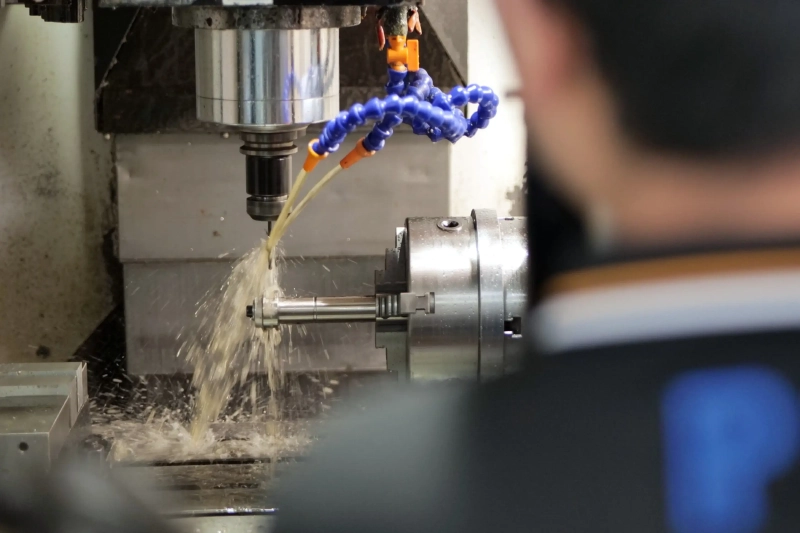
When a Wisconsin automotive supplier redesigned a transmission bracket—eliminating sharp internal corners and replacing them with 2 mm fillets—the results were dramatic. Stress concentration dropped by 68% (finite element analysis showing a Kt factor of 1.2 vs. 3.8 for sharp corners), fatigue life increased 4.2× (180,000 cycles vs. 42,000 in lab testing), and assembly rejection rates fell from 12% to just 0.3% due to eliminated mating interference. Despite a modest cost increase of $0.85 per part through advanced custom CNC machining services, the investment was fully justified by the elimination of $28,000 in annual warranty claims.
This example highlights how the chamfer vs. fillet decision goes far beyond aesthetics—directly influencing structural integrity, manufacturing cost, assembly reliability, and overall product lifespan. Understanding when to apply each feature is critical to the success of any CNC-machined part.
What Are Chamfers and Fillets?
Chamfer: Beveled edge replacing 90° corner with straight angled surface (typically 45°, though 15°, 30°, 60° used for specific applications). Created through single-pass toolpath with chamfer mill or angled approach.
Fillet: Rounded edge with radius replacing sharp corner. Distributes stress gradually, essential for load-bearing applications and mandatory for internal CNC-machined corners (tool geometry prevents sharp internal corners).
Chamfer vs Fillet: Comprehensive Comparison
A chamfer is a straight, angled edge (usually 45°) that is quick, simple, and cost-effective to machine using a chamfer mill, making it ideal for deburring, assembly ease, and basic aesthetics. In contrast, a fillet is a curved radius edge that takes longer to machine, requires specialized tools like a ball endmill, and costs about 20–40% more.
Functionally, fillets are superior for reducing stress concentration (lower Kt), improving strength, and are essential for internal corners due to tool geometry. Chamfers, while faster and cheaper, have higher stress concentration and are mainly used where strength is not critical.
When to Use Chamfers: Applications and Advantages
Chamfer advantages:
- Faster machining: Single-pass 45° chamfer mill completes edge 40-60% faster than radius cut
- Simpler programming: Straight-line toolpath vs complex arc interpolation
- Better for assembly: 45° lead-in guides fasteners/pins into holes (self-centering effect)
- Deburring efficiency: Removes sharp edges preventing handling injuries, improves aesthetics
- Lower cost: Reduced cycle time = lower manufacturing cost ($0.15-0.40 per chamfer vs $0.25-0.75 per fillet typical)
Optimal chamfer applications:
- External edges requiring deburring (safety, aesthetics)
- Fastener holes (countersink lead-ins)
- Assembly alignment features (mating part guidance)
- Sheet metal parts (beveled edges)
- Non-load-bearing decorative edges
- Cost-sensitive high-volume production
Standard chamfer specifications:
- Small parts (<50mm): 0.5mm × 45° or 1mm × 45°
- Medium parts (50-200mm): 1-2mm × 45°
- Large parts (>200mm): 2-3mm × 45°
- Aerospace/precision: 0.3-0.5mm × 45° (tight tolerances)
When to Use Fillets: Structural and Manufacturing Requirements
Fillet advantages:
- Stress distribution: Gradual radius reduces stress concentration factor (Kt) from 3-4 (sharp corner) to 1.1-1.5 (generous fillet)
- Fatigue resistance: Distributed stress prevents crack initiation, critical for cyclic loading
- Mandatory for internal corners: CNC endmill radius creates fillet automatically (sharp internal corner impossible)
- Improved flow: Smooth transitions for fluid/air flow in housings, manifolds
- Better aesthetics: Organic appearance for consumer products
Optimal fillet applications:
- Internal machined corners (unavoidable—tool creates radius)
- Load-bearing structural components (brackets, mounts, frames)
- Fatigue-critical parts (suspension, drivetrain, rotating components)
- Pressure vessels (stress concentration causes failure)
- Aerospace/medical (safety-critical applications)
- Molded/cast part interfaces
Fillet radius selection:
- Match tool radius when possible: Available endmill radii (R0.5mm, R1mm, R1.5mm, R2mm, R3mm, R5mm)—using available tool eliminates custom tooling cost
- Larger radius = lower stress: R3mm fillet has 30% lower Kt than R1mm fillet
- Minimum radius = tool radius: Cannot machine smaller internal radius than tool radius used
- Design rule: Internal pocket corners minimum R2-3mm (common 1/8″ or 3mm endmill radius)
CNC Machining Realities Affecting Design Decisions
Internal corners always have fillets: CNC endmill creates radius equal to tool radius. Designer specifying sharp internal corner forces machinist to either: (1) Use tiny tool (expensive, slow, fragile), (2) Add relief cuts (extra operations), (3) Request design change. Solution: Specify internal corner radii matching standard tool sizes (R1mm, R2mm, R3mm, R5mm).
External edges: chamfer faster/cheaper: External corner chamfering via single chamfer mill pass (30-45 seconds) vs fillet requiring ball endmill multiple passes (60-90 seconds). High-volume production amplifies time difference—10,000 parts × 30-second savings = 83 hours saved.
Tool access determines feasibility: Deep pockets, narrow slots may prevent large radius tools reaching internal corners—design must accommodate tool geometry.
Cost Analysis: Chamfer vs Fillet Economics
Machining cost breakdown (typical aluminum part, external edge):
- Chamfer (1mm × 45°): $0.25-0.40/feature (single-pass, 30-second cycle)
- Fillet (R2mm): $0.40-0.75/feature (multiple-pass, 60-90 second cycle)
- Cost premium: Fillets 40-60% more expensive per feature
Total cost consideration: Part with 12 edges—chamfering all costs $3-5 vs filleting $5-9. For 10,000-unit production run: $20,000-$40,000 difference.
Strategic optimization: Use fillets only where structurally required (internal corners, load-bearing edges), chamfer everywhere else (non-critical external edges) optimizing cost vs performance.
Design Guidelines Preventing Manufacturing Issues
Chamfer best practices:
- Standard 45° angle unless specific requirement (30° or 60° for special cases)
- 0.5-2mm size range most economical (standard tooling)
- Apply consistently (same size throughout part reduces tool changes)
- Specify on drawing: “0.5 × 45° chamfer” or “1mm chamfer” notation
Fillet best practices:
- Match standard tool radii (R1mm, R2mm, R3mm, R5mm—eliminates custom tooling)
- Larger radius = stronger part + potentially lower cost (larger tools cut faster)
- Minimum internal radius = 0.5mm (smaller requires micro-tooling, expensive/fragile)
- Specify on drawing: “R2 fillet” notation
Common design errors:
- Tiny fillets everywhere: R0.2mm radius requires expensive micro-endmills, slow machining—use R1-2mm minimum unless precision requirement mandates smaller
- Sharp internal corners: Impossible to machine—always specify radius
- Inconsistent sizes: Varying fillet radii (R1, R1.5, R2.3, R2.7) forces multiple tool changes—standardize to 2-3 sizes maximum
- Over-engineering non-critical edges: Filleting decorative edges wastes money—chamfer adequate
Stress Concentration and Fatigue Implications
Stress concentration factor (Kt): Ratio of peak stress at feature to nominal stress. Sharp corner Kt = 3-4 (stress 3-4× higher), generous fillet Kt = 1.1-1.3.
Fatigue life relationship: Part with Kt = 3 fails at ~30,000 cycles vs Kt = 1.2 failing at 150,000+ cycles (5× improvement through proper filleting).
Critical applications requiring fillets: Rotating components, vibrating assemblies, pressure-cycled housings, suspension components—anywhere cyclic loading exists.
Strategic Feature Selection for CNC Design
Chamfers for: External edges (deburring, assembly, aesthetics, cost optimization), fastener holes (lead-ins), non-structural decorative elements, high-volume cost-sensitive production.
Fillets for: Internal machined corners (manufacturing requirement), load-bearing structures, fatigue-critical components, stress-sensitive applications, pressure vessels, safety-critical parts.
Hybrid approach optimal: Fillet where strength dictates (internal corners, loaded edges), chamfer everywhere else (external non-critical edges) balancing performance with manufacturing economics.
Understanding custom cnc machining services requires knowing these design fundamentals—skilled manufacturers like FastPreci provide design-for-manufacturing feedback optimizing chamfer/fillet usage before production, preventing costly revisions while ensuring parts meet structural requirements at optimal cost.
What chamfer vs fillet design challenge is preventing confident part specification—internal corner radius selection, cost vs strength optimization, stress analysis requirements, or tool access uncertainty?