

Summary
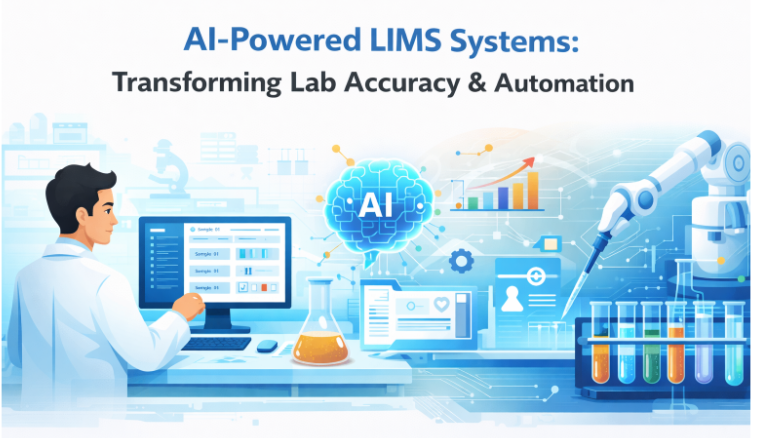
In today’s healthcare ecosystem, lab departments are constantly under pressure to maintain accuracy, speed and compliance. Manual process increases the possibilities of error in the system. AI-Powered LIMS systems provide a holistic solution for lab centers to confront such intricate hurdles. LIMS automates sample collection, result verification, inventory management and documentation. This minimizes manual work pressure and errors and expedites the turnaround time. In this blog, I will discuss how AI-Powered LIMS Systems help lab centers simplify their daily operations with better accuracy, automation, and complete operational control. Also, I will cover how LIMS flags abnormal reports, predicts the workflow and ensures secure data management. Keep reading!!!
Introduction
The laboratory division is under a lot of strain in the current healthcare system. Every day the laboratory department processes more than a thousand samples and generates reports. A small mistake can disrupt the patient care. Manual data entry, paperwork overload, delayed reporting, and compliance stress all together make the laboratory operation complex.
Do you think the traditional system can comply with the speed or accuracy expectations of the current ecosystem? To combat such circumstances, it is absolutely vital for clinics to incorporate AI-Powered LIMS Systems. AI powered laboratory management system is not just a tool for storing data. It is an intelligent command center that automates the lab workflows, drastically reduces the human errors, and makes every operation capable of intelligence.
LIMS software automatically warns about unusual outcomes, anticipates process steps through predictive algorithms and generates audit trails with a secure structure. In 2026, laboratories are no longer just testing centers. AI-enabled LIMS provide comprehensive accessibility control, encrypted information management, and constant monitoring to keep the lab environment confidential. Simply put, AI-Powered Laboratory information management system is a versatile solution that keeps the lab operation ahead of the curve.
Core Components of AI in LIMS
Smart Data Brain – Central Repository
The most significant part of LIMS is the smart data brain. Furthermore, It works as an intelligent hub. It securely stores all the lab’s key instrument outputs, technician logs, patient documentation, and even environmental sensor data in a single platform. In the traditional system, lab centers face challenges with data. Data was kept in different locations. However, LIMS helps centers to combat the challenges of scattered data. It minimizes the problems of dispersed files and manual consternation completely. Additionally, the lab department gets clear visibility, which accelerates the decision-making, and every department works on the same page.
Intelligent Data Entry
As we all know, mistakes are common when entering data manually. Furthermore, manual data entry is a risky step. A small spelling mistake and wrong digit can impact the entire lab’s results. This is where the true power of AI-powered OCR technology emerges!!. Lab software automatically reads patient data and test information once you scan the barcode on the sample label. Moreover, the lab system minimizes the work pressure of typing text, optimizes the report compilation procedures, and prevents transcription blunders. Consequently, making the data handling process efficient, dependable and trouble-free. Read our blog to know more about lab cost reduction strategies.
Automated Validation Engine
Every lab professional knows that report validation is the most crucial step. Furthermore, it becomes tiresome for lab specialists to compare each report manually and align it with previous reports. However, an AI-powered validation engines can handle those responsibilities with intelligence. Moreover, the system automatically checks and compares the current results with historical benchmarks and preset reference specifications. Lab software automatically flags alerts or sends notifications to specific lab teams if any unusual surge or abnormal variation occurs. Therefore, lab software improves the accuracy in the system. It prevents the workload of repetition on patients’ cases, and lab technicians can confidently work.
Robotic Process Automation (RPA)
In Lab department , there are many task that are monotonous such aliquotting, inventory confirmation, documentation revisions, and status updates. Further, it consumes valuable time of the lab specialist. In traditional software, lab specialists have to manually perform the mundane tasks and at some point, it drains their energy. AI-driven RPA tools automatically handle all the routine mundane tasks of lab centers. Moreover, lab software minimizes errors and enables intuitive workflows in the system. With LIMS ,lab teams can invest their effort in serious case assessment and holistic operations.
IoT Integration
In modern labs, equipment reliability is equally important. A small breakdown can cause reporting delays. Furthermore, when AI-enabled LIMS are properly amalgamated with IoT devices. Lab management systems can automatically capture machine status, temperature levels, calibration schedules and performance metrics in real time. The lab system discovers any peculiar pattern or failure risk and sends warning signals wherever necessary. Moreover, this proactive monitoring avoids sudden downtime. Regular maintenance takes place. Plus, lab productivity consistently becomes high.
Predictive Intelligence
AI not only manages present data but also prepares a future roadmap. Through Neural networks and NLP technologies, the lab system analyzes the past trends and recognizes the workload patterns. Further, lab software can determine the day when sample volume will be higher and which machine will need maintenance. AI can predict all the workflows beforehand. Plus, it highlights the operational gap. Thus, it makes the entire lab operation more proactive and resilient to the future.
Enhancing Lab Accuracy
Anomaly Detection
In the lab, every value is important, but sometimes a small abnormal entry remains invisible. Furthermore, AI powered anomaly detection works silently in the background and prevents the system from creating discrepancies. Lab software within a hospital management system is powered by unsupervised machine learning algorithms that identify normal and abnormal patterns in advance. As new test results enter the system, AI instantly compares them with historical data and predefined reference ranges. The AI-enabled lab module also sends real-time alerts to the medical team if it detects sudden spikes, unexpected drops, or inconsistent trends, ensuring faster response and improved diagnostic accuracy.
Instant Data Scrutiny
In a lab environment, speed and precision are equally important. As new tests load into the system, AI instantly starts analyzing the process. It does not wait for manual reviews. Further, the system matches every value with reference ranges, past trends and related parameters and compares the data thoroughly. It sends alerts if any uncertainties are present in the new data. Thus, helping lab centers prevent errors at the early stage and create a smooth environment.
pH Deviation Alert
The pH reading often exceeds the expected range during a routine test. It takes time to detect such an unexpected deviation in a traditional system. However, AI LIMS instantly detects such uncertainties that go beyond the threshold. Further, lab systems do not just simply send alerts but also analyze the complete context. Lab management software is adept at evaluating sample type, reagent batch, and recent instrument calibration procedures. Additionally, it suggests recommendations for correction and secure log traceability for every action. Lab software improves accuracy and induces strong compliance in the system.
Self-Learning System
The AI laboratory management system is not a static software that follows only fixed rules. Further, it is a self-learning system that becomes sharper with time through supervised learning. Similar to a human, the system learns more patterns progressively and refines its accuracy as it processes new data. In high-volume biotech quality control labs, this approach drops the error rate to 0.1%. In simple words, the more the system processes the data, the more it learns from it and improves its efficiency and precision.
Immutable Audit Trails
In regulated labs, there is one common question: “Who changed what, and when?” Further, traceability is not an optional feature here; it’s an indispensable requirement. The blockchain-based AI-LIMS keeps immutable audit logs in which all changes, approvals, and data updates are automatically noted. These records are tamper-proof; only authorized access can delete, modify and update records. This helps lab centers create a seamless workflow during the time of audits. They get complete transparency, which creates strong compliance in the system. Additionally, management can meet the compliance requirement with certainty, without taking unnecessary stress.
Automation of Workflows
Smart Automation Engine
AI-powered LIMS systems combine rule-set engines with reinforcement learning. Further, Lims system don’t just follow fixed rules; they learn from workload and past performance. System can easily learn which instrument is free and which machine has more queues, and which sample is on urgent priority. By analyzing these factors, the system automatically routes the sample to the best-suited instrument. Moreover, this intelligent routing minimizes the delays, the workload remains balanced, and lab operations run smoothly and efficiently.
LAS Integration
When a lab management system connects seamlessly with Lab automation systems, then it creates a perfect coordination, where humans and robots work in the same rhythm. Further, the system provides clear, real-time instructions to lab specialists and automates the sample transfer, sorting and processing. Overall, it eliminates the delays and manual handoffs.
Workflow Activation with Barcode
In a busy clinical or lab setting, every second matters. As the barcode scans the sample, it automatically fetches patient metadata and assigns the correct test panel, such as hematology or biochemistry. This activates the workflow automatically. It automatically updates the status of each workstation in real time, eliminating the need for manual coordination.
Conclusion
AI-powered LIMS systems take the laboratory workflow to the highest level. This is not just a software upgrade; it’s a complete operational transformation. By combining accuracy, automation aur intelligence, it makes the lab’s practices truly oriented toward results. AI-powered LIMS not only help labs handle current challenges but also make them proactive for the future.