
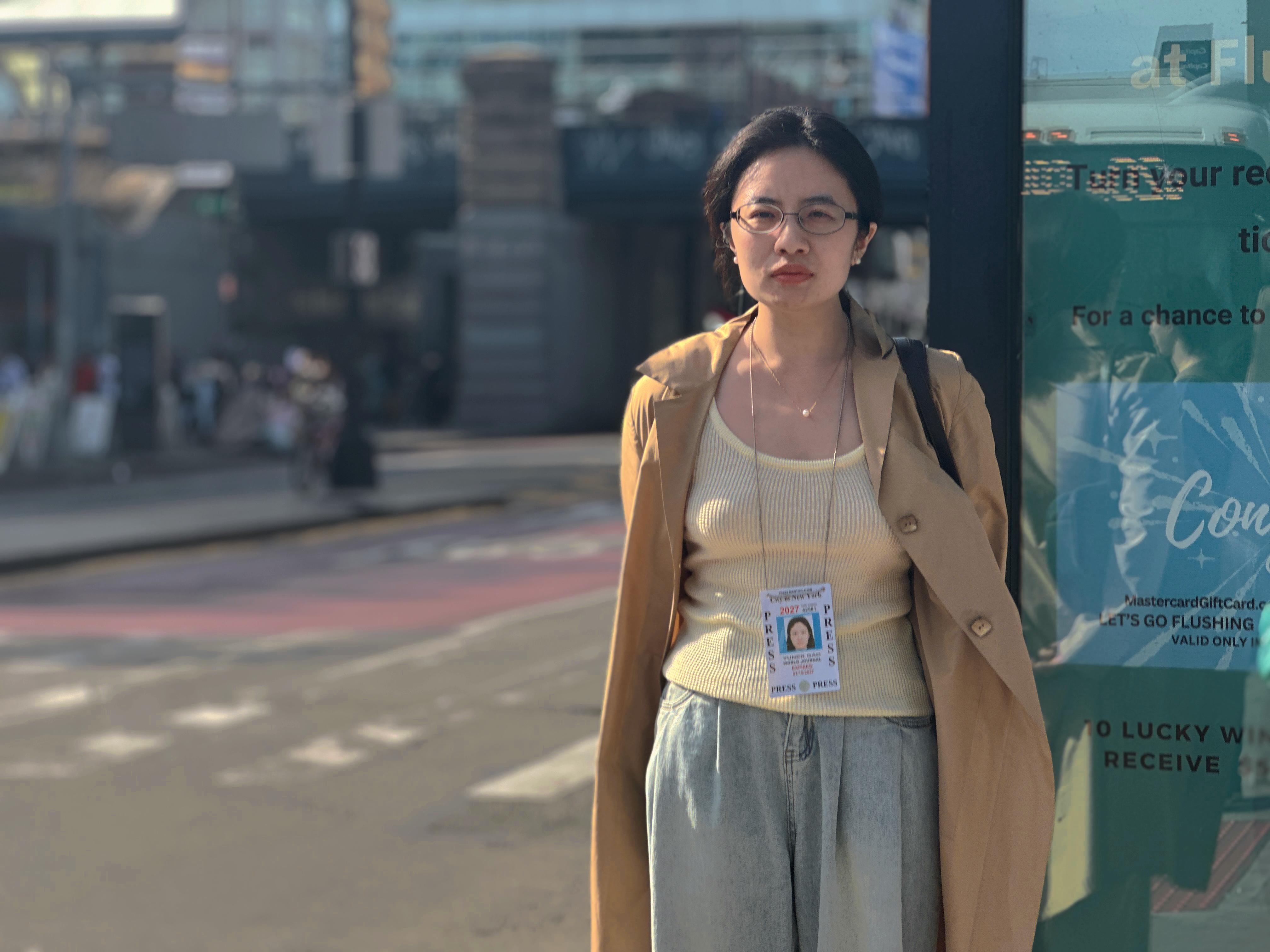
By Sarah Thompson, Senior Editor, Digital Journal
November 2025
As artificial intelligence reshapes America’s economic landscape, one filmmaker is capturing its human dimension with rare foresight. Yuner Gao, a New York-based journalist and founder of New Horizons Media Inc., is spearheading American Dreamers in the Age of Artificial Intelligence, a ten-year documentary series that promises to redefine how we view technology’s integration into small businesses. In a media industry hungry for authentic narratives, Gao’s project stands as a beacon of insight, blending journalistic rigor with cinematic ambition to illuminate a pivotal moment in U.S. innovation.
Gao’s credentials anchor her vision. A recent Hofstra University Master’s in Journalism graduate (GPA 3.66), she mastered news writing, TV packaging, and digital journalism, culminating in a feature story on fentanyl addiction that drew on interviews with a drug dealer, a task force, and university experts. This investigative depth builds on her nearly three years at World Journal, where she has authored hundreds of stories on civic life and economic trends as part of her more than a decade of reporting across the United States and Asia, and her earlier work in China for newspapers, social media, and a PR agency, honing skills in interviewing, press articles, and advertising writing. Her bilingual fluency in English and Mandarin enables her to bridge cultural perspectives, a skill evident in award-winning documentary shorts. Now, as Founder, Director, and Executive Producer of New Horizons, Gao is scaling her storytelling to chronicle entrepreneurs like Ray Sang of Chipmunk Robotics, Haitian Yuan of ReviewSpark, and Jifeng Nan, an Irvine-based consultant. Their efforts, from automating manufacturing to streamlining analytics, reflect AI’s quiet revolution, with 37% of mid-size U.S. businesses adopting it by 2024, up from 8% in 2018 (McKinsey Global Survey). The genius of American Dreamers lies in its longitudinal approach. Rather than chasing headlines, Gao’s series revisits its subjects annually, building a cinematic archive over a decade. Early pilots, amassing 60 hours of 4K footage, showcase Yuan’s platform reducing review errors by 25% and Sang’s Inkwise AI cutting marketing costs by 30%, though challenges like CHIPS Act regulations persist. Nan’s consulting, aligned with NIST’s AI Risk Management Framework, guides startups toward ethical adoption. This patient storytelling, rare in a nonfiction genre growing 11% annually (Motion Picture Association 2024), offers a nuanced portrait of adaptation in a $134 billion media industry.
Gao’s operation mirrors her subjects’ efficiency. New Horizons, launched with a $50,000 investment ($20,000 for equipment, $15,000 for production, $10,000 for post-production, $5,000 for legal costs), keeps per-episode costs at $20,000 to $30,000. A compact team, including cinematographer Yingqun Zhu, editor Honghui Qiu, coordinator Siyi Chen, associate producer Chengyu You, and advisor Shangbiao Dong, leverages AI tools like Adobe Sensei for captioning and DaVinci Resolve’s Neural Engine for grading, slashing timelines by 30%. This dual use of AI, as subject and production aid, underscores Gao’s innovative edge. Revenue from PBS royalties, Sloan grants, and educational licenses is projected to reach $500,000 to $1 million over ten years, with 40% reinvested into a Library of Congress archive, ensuring a lasting legacy.
Gao’s work carries national weight. Small businesses employ 61.7 million Americans (SBA data), and AI’s potential $13 trillion global GDP boost by 2030 (PwC) hinges on their success. Yet, uneven adoption risks economic divides. American Dreamers addresses this through educational packages, targeting 50 institutions and 50,000 students by Year 5 to foster tech ethics discourse. Bilingual subtitles aim for 200,000 international viewers, bolstering U.S. cultural diplomacy in Asia-Pacific markets, where documentary licensing grew 34% (PwC 2024). With 500,000 domestic viewers projected by Year 5 via Sundance and Tribeca submissions, the series aligns with the National AI Initiative Act of 2020 and Executive Order 14110, promoting public literacy.
Gao’s vision is a cultural touchstone. A PBS curator praises her “longitudinal lens” for capturing “the human code of progress,” evoking chroniclers like Studs Terkel. By documenting AI’s impact, she supports Biden’s Investing in America Agenda, highlighting job creation in a tech-driven economy. Challenges, such as funding volatility and subject privacy, remain, but Gao’s journalistic discipline, honed across Chinese and U.S. media, builds trust. Her series, projecting 750,000 cumulative views by 2029, positions her as a leader in a nonfiction market claiming 18% of viewing hours (MPA 2024). In an age of fleeting content, Gao’s commitment to depth over speed is refreshing. American Dreamers not only documents America’s AI frontier but shapes how we understand it, proving media’s power to inform and inspire. As editors, we see Gao as a trailblazer, crafting a narrative legacy for an adaptive nation.
About the Subject: Yuner Gao, a New York-based journalist and filmmaker, founded New Horizons Media Inc. to explore technology’s human impact. Learn more at https://www.linkedin.com/in/yuner-gao-898a57124/ or newhorizonsmedia.com.
