
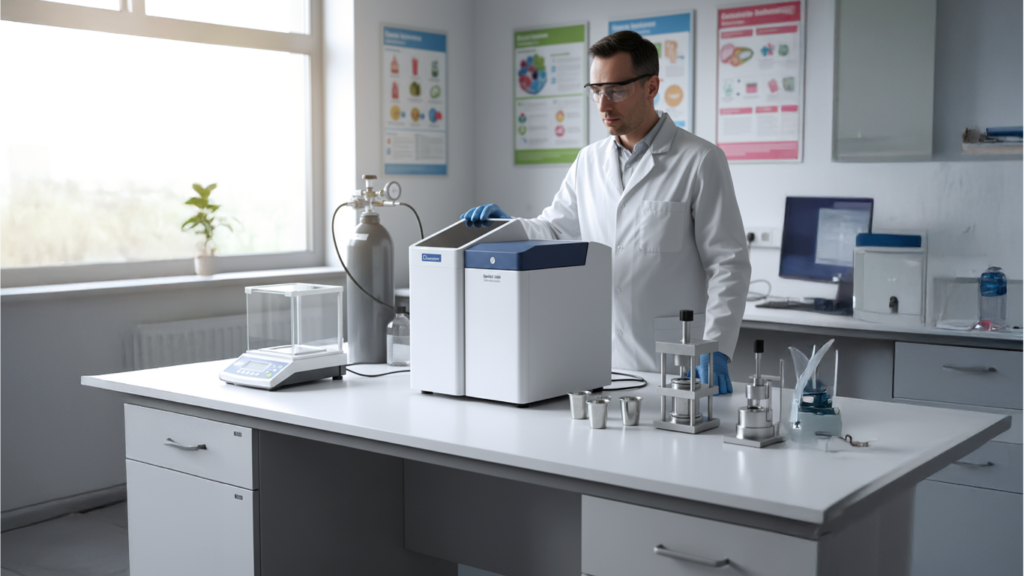
The bomb calorimeter is the absolute standard for measuring the heat of combustion in solid and liquid materials. In the exacting fields of material science, fuel characterization, and thermodynamic research, vague estimations of energy content are unacceptable. Laboratory professionals require precise, reproducible data.
Unlike open-system calorimetry, which is susceptible to atmospheric interference, this apparatus operates under isochoric (constant-volume) conditions. This allows researchers to capture the gross calorific value (GCV) of a substance with near-perfect accuracy, making it an indispensable tool for everything from coal mining to nutritional analysis.
What Is a Bomb Calorimeter?
To truly understand the value of this instrument, we must first define what is a bomb calorimeter in the context of thermodynamic laws.
Technically, it is a thick-walled steel vessel designed to withstand high internal pressure and temperature. While simple laboratory setups (like “coffee cup” calorimeters) operate at constant pressure, bomb calorimeters operate at constant volume.
This distinction is critical due to the First Law of Thermodynamics. In a chemical reaction, the change in internal energy (ΔU) is equal to the heat evolved (q) plus the work done (w) on the system.
ΔU = q + w
Since work is defined as pressure times the change in volume (P × ΔV), and a rigid steel bomb prevents any volume change (ΔV = 0), no expansion work is performed. Therefore, the heat measured (qv) is equal to the change in internal energy (ΔU). This makes the bomb calorimeter the only reliable method for measuring the specific energy of explosive or rapid-combustion reactions.
The Oxygen Bomb Calorimeter: Anatomy and Mechanism
The most widely adopted iteration of this technology is the oxygen bomb calorimeter. Its design focuses on ensuring the complete oxidation of the sample, as incomplete combustion (resulting in soot or carbon monoxide) renders data invalid.
Core Components
The Bomb: A vessel typically machined from corrosion-resistant stainless steel (often Grade 316) capable of handling pressures up to 30 atmospheres (approx. 440 psi).
The Bucket: A container holding a precisely weighed volume of water, in which the bomb is submerged.
The Jacket: An outer thermal shield. In adiabatic calorimeters, this jacket is temperature-controlled to match the bucket, eliminating heat transfer. In isoperibol calorimeters, the jacket remains at a constant temperature, and calculations correct for thermal leakage.
Ignition System: Electrical leads connected to a fuse wire (often nickel-chromium or platinum).
The Operational Workflow
The testing process follows a strict protocol to ensure safety and accuracy:
Sample Preparation: The material is pulverized (if solid) and pelleted to manage the burn rate. A known mass (usually roughly 1g) is placed in the crucible.
Charging: The bomb is purged of atmospheric air and charged with pure oxygen. This excess oxygen ensures the reaction is limited only by the sample mass, not the oxidant.
Equilibration: The system is assembled, and the stirrer is activated. The operator must wait for the water temperature to stabilize, establishing a clear initial temperature baseline (T-initial).
Firing: The operator triggers the ignition current. The fuse wire burns, igniting the sample. The temperature rises rapidly.
Data Collection: A high-resolution thermometer (often reading to 0.0001°C) records the peak temperature (T-final).
The Mathematics: Mastering the Bomb Calorimeter Equation
For laboratory managers and students, the raw temperature data is useless without the bomb calorimeter equation. This mathematical framework converts a shift in degrees Celsius into Joules or Calories.
The Fundamental Formula
The primary calculation rests on the principle that the heat released by the sample is equal to the heat absorbed by the calorimeter assembly.
The basic bomb calorimeter formula is:
q(rxn) = – (C(cal) × ΔT)
q(rxn): The total heat of reaction.
C(cal): The Heat Capacity (or “Water Equivalent”) of the calorimeter. This represents how much energy is required to raise the entire system (water + steel bomb + thermometer) by one degree.
ΔT: The corrected temperature rise.
Advanced Bomb Calorimeter Calculations
In high-precision ASTM or ISO standard testing, a simple multiplication is insufficient. We must account for external energy inputs that are not part of the sample’s chemical energy.
The expanded formula used in professional bomb calorimeter calculations is:
Hc = (W × ΔT – e1 – e2 – e3) / m
Where:
Hc: Gross Heat of Combustion (Energy per mass, e.g., MJ/kg).
W: The Energy Equivalent of the calorimeter (calibrated value).
ΔT: The corrected temperature rise.
e1 (Acid Correction): Nitrogen in the air (or sample) reacts at high pressure to form nitric acid, releasing exothermic heat. This heat must be subtracted.
e2 (Fuse Wire Correction): The burning of the ignition wire releases heat. Since this energy comes from the wire, not the sample, it is subtracted.
e3 (Sulfur Correction): If the sample contains sulfur, it forms sulfuric acid, releasing additional heat that requires adjustment.
m: Mass of the sample.
Ignoring these corrections can lead to errors of 1% to 3%, which is unacceptable in commercial fuel trading or aerospace applications.
Calibration: The Role of Benzoic Acid
How do we know the value of C(cal) or W in the equations above? We cannot calculate the heat capacity of the steel and water theoretically with enough precision. Instead, we calibrate the instrument.
Calibration involves burning a standard reference material—almost exclusively Benzoic Acid (C6H5COOH). Benzoic acid has an internationally accepted heat of combustion (26.454 kJ/g). By burning a known mass of benzoic acid and measuring the temperature rise, we work the equation backward to find the unique heat capacity of that specific calorimeter setup.
Industrial Applications and Standards
While often associated with university physical chemistry labs, bomb calorimeters are critical infrastructure in the global economy.
1. Energy and Fuels (Coal, Oil, Biomass)
In the power generation sector, the price of coal is dictated by its calorific value. Testing follows strict standards like ASTM D5865 (Standard Test Method for Gross Calorific Value of Coal and Coke). A variance of even 50 BTU/lb can represent millions of dollars in transaction discrepancies between a mining company and a power plant.
2. Waste-to-Energy and Incineration
As the world moves toward sustainable waste management, plants need to know if municipal waste burns hot enough to generate electricity. Calorimetry determines the viability of Refuse-Derived Fuel (RDF).
3. Propellants and Explosives
In aerospace and defense, engineers need to know the exact energy density of rocket propellants. Bomb calorimeters provide the data necessary to model thrust and burn rates for solid rocket boosters.
4. Food Science and Metabolism
The “Calorie” on a nutrition label is effectively a measure of heat. While modern food labeling often uses the Atwater system (adding up protein, fat, and carbs), calorimetry is the primary method used to determine the energy density of new food ingredients and additives.
Selecting the Right Equipment
Not all bomb calorimeters are created equal. The market ranges from manual, static-jacket units suitable for teaching basic thermodynamics, to fully automated, microprocessor-controlled adiabatic systems used in high-throughput commercial labs.
Modern units now feature automatic oxygen filling, automatic vessel washing, and integrated software that performs the complex corrections for fuse wire and acid formation automatically.
Final Thoughts on Precision
Precision is the currency of the scientific world. Whether dealing with the thermodynamics of a new biofuel or certifying a shipment of anthracite coal, the bomb calorimeter remains the ultimate arbiter of energy content.
Understanding the nuance of the bomb calorimeter formula and the mechanical precision of the oxygen bomb allows laboratories to deliver data that drives industry forward. Accuracy in these measurements ensures fair trade in energy markets, safety in propulsion, and clarity in nutritional science.
If your laboratory requires state-of-the-art thermal analysis equipment to meet these rigorous standards, you need a partner who understands precision. Visit Qualitest or WorldofTest to explore our comprehensive range of calorimetry and materials testing solutions today.
