
After years in the biotech industry, Xuefei Gao began to notice a persistent gap: despite an explosion of data, the pace of drug development hadn’t meaningfully accelerated. Scientists had more tools and datasets than ever—but connecting the dots across them remained painfully slow.
Gao’s experience in biotech venture investment, combined with her MBA and MPH training at Yale, gave her a front-row view of the challenge. While working with several Yale life science spinouts on business strategy, she realized that an AI system trained to think like a scientist—not just automate tasks—could fundamentally reshape how research is done.
“The typical AI tools in drug discovery are designed to solve specific problems—predict a protein structure, screen a compound library, analyze imaging data,” Gao explains. “What if we could create something that actually thinks through the entire scientific process, not just executing individual tasks?”
Building an AI Research Partner
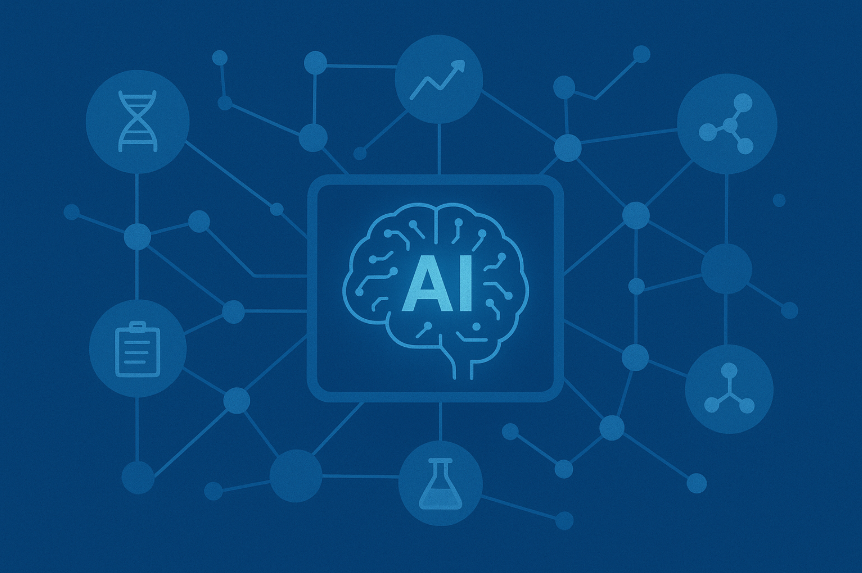
Today, as co-founder and COO of Ascent Bio, Gao is leading that vision. The company, founded in collaboration with AI researchers from a leading Yale lab, is developing what it calls an AI scientist—a system designed to reason through complex scientific questions, integrate data across sources, and run computational models that support drug discovery from idea to insight.
The distinction matters. While existing AI tools in biotech might predict molecular properties or screen compounds, they typically operate in isolation and require specialized coding expertise. A medicinal chemist without computational training often struggles to leverage these advanced tools effectively.
“Think about a medicinal chemist working on a new drug target,” Gao says. “They might have deep expertise in chemistry but limited experience with genomic analysis or computational modeling. Our AI essentially becomes their computational research partner, enabling them to ask questions and explore hypotheses across disciplines they haven’t traditionally worked in.”
The technology orchestrates entire analytical workflows. When a researcher investigates potential treatments for a rare disease, the AI can autonomously mine scientific literature, analyze genetic data, propose candidate molecules and simulate their interactions—all while explaining its reasoning at every step.
From Investment to Innovation
At Ascent Bio, Gao oversees product strategy, partnerships, and operations. Her cross-disciplinary background—spanning biotech venture capital, business strategy, and scientific innovation—has been central to shaping the company’s direction.
“Coming from venture capital, I understand that technology alone isn’t enough,” Gao notes. “The question is always: can pharmaceutical companies actually use this in their existing workflows? Can scientists trust the outputs enough to base critical decisions on them? We need to ensure we build something both scientifically rigorous and practically deployable.”
Recognition from Academia and Industry
Since its founding, Ascent Bio has been recognized by both academic and industry leaders. The company received Yale’s 2024 Faculty Innovation Award and was selected for Merck’s Digital Science Studio, a highly competitive program supporting disruptive startups in digital biopharma.
Gao has also become an active voice in the biotech and innovation ecosystem. She has spoken at events hosted by Nucleate, the Yale Biotech Club, Startup Yale, and other industry forums. She was invited to join the judging team for Yale School of Management’s Donor-Funded Entrepreneurial Awards—an honor she once received herself as a student entrepreneur.
“I’ve learned so much from engaging with the startup and biotech communities,” she reflects. “learning from other founders navigating similar challenges at the intersection of AI and life sciences—that’s been invaluable.”
Reimagining Drug Development Economics
As AI continues to weave deeper into scientific workflows, the conversation is shifting—from tools that optimize specific research steps to AI agents that can augment the entire discovery process. Ascent Bio’s work sits at the center of that evolution.
The implications extend beyond speed. “What we’re really talking about is extending human capability,” Gao explains. “The AI doesn’t sleep and it’s always working in service of the scientist’s creativity and intuition, not replacing it.”
This could democratize innovation, allowing smaller biotech companies and academic labs to compete with large pharmaceutical companies by accessing computational capabilities that were once prohibitively expensive.
“When you think about rare diseases affecting only a few thousand patients, the business case for drug development often doesn’t work under the traditional model,” Gao emphasizes. “But if we can make the discovery process significantly more efficient and less costly, suddenly those ‘orphan’ diseases become viable targets. That’s the kind of impact that excites me—not just faster drugs, but drugs that wouldn’t exist otherwise.”
Her work at Ascent Bio represents a bridge between the biotech industry’s traditional strengths and the transformative potential of artificial intelligence—a bridge built on both technical innovation and deep industry expertise.
